
Authentic Panchkarma Therapy for Natural Healing
Detoxify the Body. Restore Balance. Rejuvenate Mind, Body & Spirit.
Panchakarma for fertility
Panchakarma is the detoxification and rejuvenation system at the heart of every treatment plan at the clinic. Each therapy below is selected by Dr. Sagar Narkhede according to the dosha imbalance behind a woman’s specific fertility condition — never applied as a single fixed protocol.
Panchakarma — literally “five actions” — is the detoxification and rejuvenation system at the core of classical Ayurvedic medicine. At Dr. Narkhede Ayurved & Panchkarma Clinic, it is the foundation of nearly every fertility treatment plan, because most female infertility conditions trace back to accumulated Ama (toxins) and dosha imbalance that herbal medicine alone works on more slowly and less completely. This article explains what Panchakarma actually involves, the therapies used, and how each is matched to specific fertility conditions.
Why detoxification comes before treatment
Ayurveda holds that herbal medicine works best once the body’s channels (srotas) are clear. Ama — undigested metabolic toxin that builds up from weak Agni (digestive fire) — tends to settle in the reproductive channels over time, disturbing the doshas that govern menstruation, ovulation, and conception. Introducing nourishing or corrective herbs into a system still congested with Ama produces limited results, which is why Panchakarma is typically the first stage of treatment rather than an optional add-on.
How Panchakarma works
Whichever Panchakarma therapy is used, it is always delivered in three stages — this is what makes it a complete process rather than a single procedure.
1. Purvakarma
Preparatory stage — Abhyanga and Swedan are used to loosen toxins (Ama) and prepare the body’s channels before the main therapy.
2. Pradhankarma
The main therapy itself — Vaman, Virechan, Basti, Nasya, Raktamokshan, or Uttar Basti — matched to the dosha and condition.
3. Paschatkarma
Post-therapy stage — diet and lifestyle guidance to help the body re-establish Agni and stabilise the effect of treatment.
This structure is what makes Panchakarma a complete process rather than a single procedure — skipping the preparatory or post-therapy stages significantly reduces how effective the main therapy can be.
Panchakarma therapies used at the clinic
From preparatory oil massage to the specialised uterine therapies used specifically for fertility, each of the following plays a distinct role in treatment.
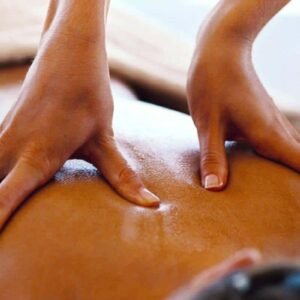
Abhyanga
Preparatory · whole-body oil massage
Warm medicated oil massage applied over the whole body, chosen according to the dominant dosha. It is usually the first step of Purvakarma, loosening Ama and improving circulation before deeper therapies begin.
Used for
Preparing the body for Panchakarma; ongoing Vata pacification between therapies.
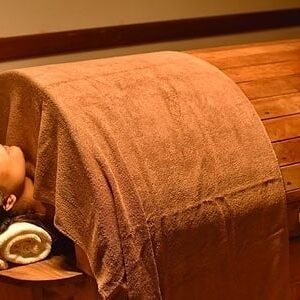
Swedan
Preparatory · medicated steam therapy
Herbal steam applied after Abhyanga to open the body’s channels (srotas) and further mobilise Ama, making the main Panchakarma therapy more effective. Also used on its own to relieve Vata-driven stiffness and pelvic heaviness.
Used for
Completing Purvakarma alongside Abhyanga; easing Kapha-driven heaviness.
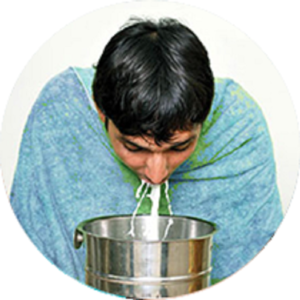
Vaman
Main therapy · therapeutic emesis
A supervised, medically controlled emesis therapy used for deep Kapha detoxification. It is one of the more intensive Panchakarma procedures, reserved for cases where Kapha and Ama accumulation is significant.
Used for
Deep-seated Kapha congestion in the reproductive channels.
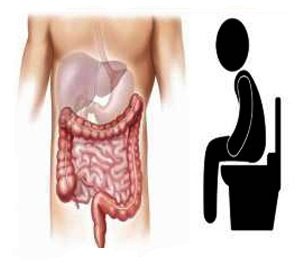
Virechan
Main therapy · therapeutic purgation
A controlled purgation therapy that clears vitiated Pitta and Kapha from the system. It is one of the most frequently used Panchakarma therapies for fertility conditions, since so many involve Pitta-Kapha toxin accumulation.
Used for
Clearing Ama and Pitta-Kapha vitiation from the reproductive channels.
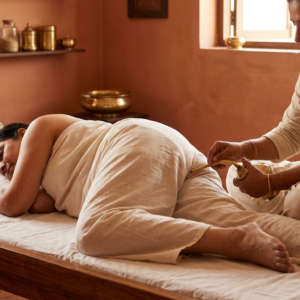
Basti
Main therapy · medicated enema
Considered the principal therapy for Vata disorders in Ayurveda. Medicated oil or decoction is administered rectally to pacify Vata and restore its natural downward movement, which governs the timing and rhythm of the menstrual cycle.
Used for
Correcting Vata vitiation across almost every fertility condition.
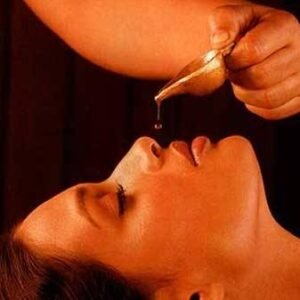
Nasya
Main therapy · nasal administration
Medicated oil or herbal powder administered through the nostrils, used in Ayurveda to work on the head and neck region, which is considered closely connected to hormonal regulation. Often used to calm stress-driven Vata, a common contributor to irregular cycles.
Used for
Stress-related Vata aggravation affecting the reproductive cycle.

Raktamokshan
Main therapy · selective bloodletting
A precise, selectively used therapy for conditions involving significant Rakta (blood tissue) vitiation. It relieves local congestion in the affected tissue and is used only where clearly indicated, not as a routine therapy.
Used for
Rakta dushti — blood tissue vitiation.

Uttar Basti
Specialised therapy · direct uterine administration
A specialised Basti in which medicated oil or decoction is delivered directly into the uterus through the reproductive tract. This is the most targeted fertility therapy in Panchakarma, used to clear and nourish the reproductive tissue and channels directly.
Used for
Direct nourishment and channel-clearing of the uterus and fallopian tubes.
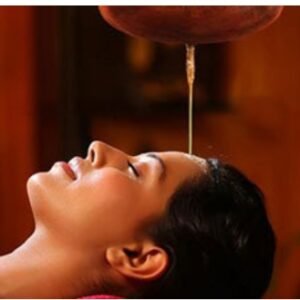
Shirodhara
Supportive therapy · continuous oil stream to the forehead
A continuous, gentle stream of warm medicated oil poured over the forehead, one of the most calming therapies in Ayurveda. Used specifically to settle aggravated Vata and reduce the chronic stress that frequently underlies irregular cycles and diminished ovarian reserve.
Used for
Deep Vata pacification and stress reduction.
Matching therapy to condition
Dr. Sagar Narkhede selects therapies based on the dosha imbalance diagnosed in each woman, not a fixed package. As a general guide:
- Menstrual irregularity typically involves Basti, Nasya, Shirodhara, and Abhyanga.
- PCOD/PCOS typically involves Vaman, Virechan, Swedan, Basti, and Shirodhara.
- Endometriosis typically involves Virechan, Uttar Basti, Raktamokshan, and Basti.
- Tubal blockage typically involves Uttar Basti, Virechan, and Basti.
- Uterine fibroid typically involves Virechan, Raktamokshan, and Swedan.
- Low AMH typically involves Basti, Abhyanga, Shirodhara, and Nasya.
Most treatment plans use a small, targeted combination of two or three therapies rather than the full set — the specific combination is decided only after a detailed Prakriti and dosha assessment.
What to expect
Some therapies, such as Abhyanga, Swedan, and Shirodhara, are gentle and can be completed comfortably in a single sitting. Others, such as Vaman and Virechan, are more intensive and carried out under close supervision, with the Purvakarma and Paschatkarma stages specifically designed to make the process manageable. A full course — including preparation and post-therapy care — is usually planned over one to two weeks, and Panchakarma can generally be used alongside other ongoing medical treatment, though this is assessed individually based on a woman’s current reports and care.
If you are exploring Ayurvedic fertility treatment and want to understand which Panchakarma therapies would be relevant to your condition, Dr. Narkhede Ayurved & Panchkarma Clinic offers a personalised consultation with Dr. Sagar Narkhede to assess your Prakriti and dosha imbalance before recommending a plan.