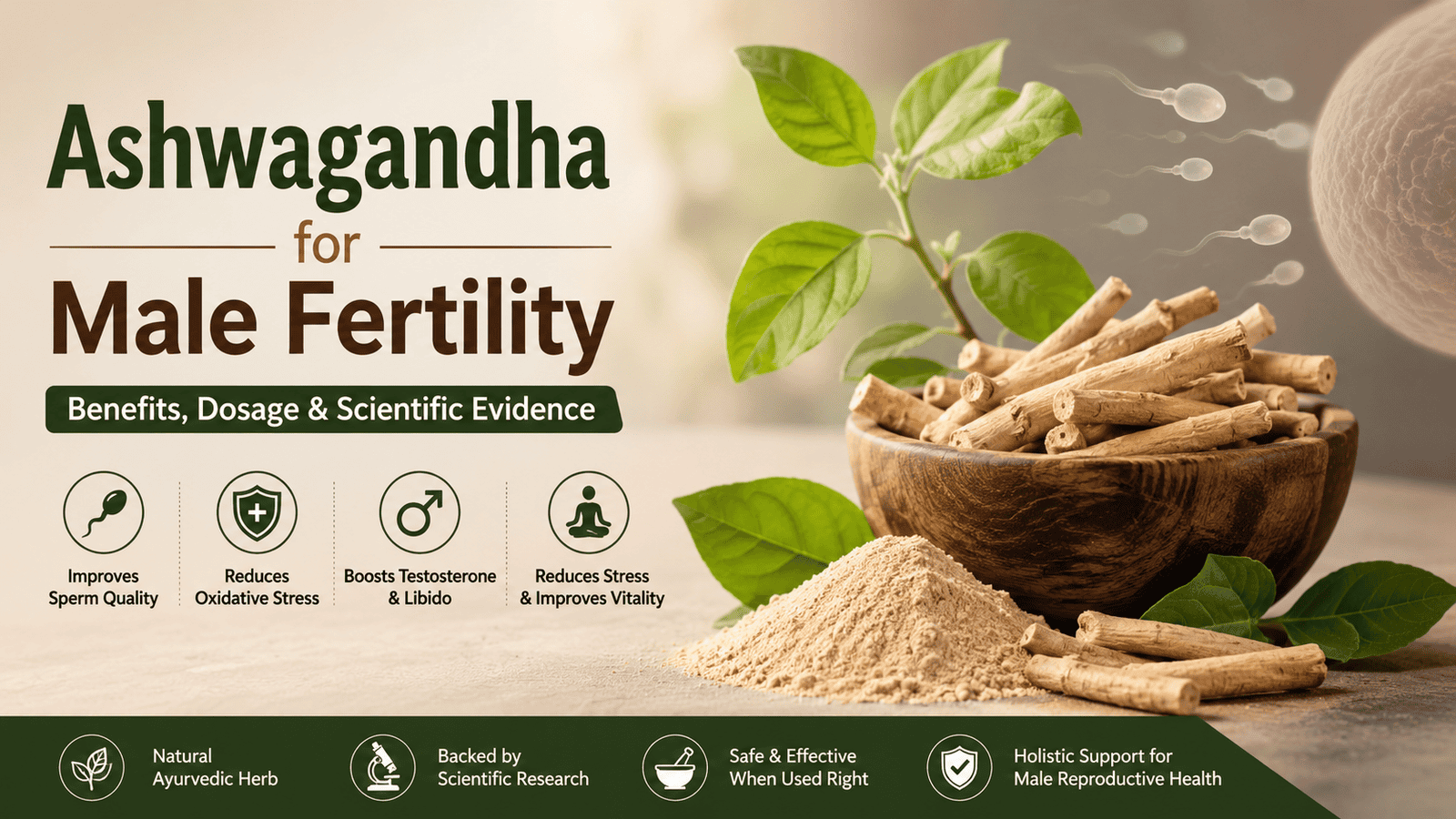
Ashwagandha for Male Fertility: Benefits, Dosage & Scientific Evidence
Among the hundreds of herbs catalogued in classical Ayurvedic texts, few have earned as much attention — both traditional and modern — as Ashwagandha (Withania somnifera). Long before clinical trials existed to study it, Ayurvedic physicians classified Ashwagandha as a Vajikarana herb: a category reserved for substances believed to restore reproductive strength, vitality, and sexual health. Today, a growing body of research is validating what this classical category described centuries ago, particularly when it comes to male fertility.
Ashwagandha for male fertility as a Vajikarana Herb
In Ayurveda, Vajikarana is one of the eight specialized branches of medicine (Ashtanga Ayurveda), dedicated entirely to reproductive and sexual health. Herbs in this category weren’t used simply to boost libido — they were understood as deep tonics for Shukra Dhatu, the reproductive tissue that Ayurveda considers the most refined and easily depleted of the body’s seven tissue layers.
Ashwagandha’s Sanskrit name translates roughly to “smell of horse,” a reference to both its distinctive root aroma and the traditional belief that it imparts the strength and vitality of a stallion. Classical texts describe it as Balya (strength-promoting) and Rasayana (rejuvenative), qualities that made it a natural fit for supporting reproductive resilience in men experiencing fatigue, low vitality, or diminished reproductive function.
The Adaptogen Connection: Cortisol, Stress, and Testosterone
Modern research offers a compelling explanation for why this ancient classification holds up: Ashwagandha is one of the most well-studied adaptogens — substances that help the body regulate its stress response.
Chronic stress elevates cortisol, and sustained high cortisol has a well-documented suppressive effect on the hypothalamic-pituitary-gonadal (HPG) axis, the hormonal pathway responsible for testosterone production. In simpler terms: prolonged stress signals the body to prioritize survival functions over reproductive ones, and testosterone output often pays the price.
Ashwagandha appears to interrupt this cycle by helping regulate cortisol levels. Several clinical studies have observed measurable reductions in serum cortisol among men supplementing with Ashwagandha extract, alongside corresponding increases in testosterone. Since testosterone plays a direct role in spermatogenesis (sperm production), this stress-cortisol-testosterone pathway is considered one of the primary mechanisms behind Ashwagandha’s reproductive benefits.
Effects on Sperm Motility, Count, and Semen Volume
Beyond its hormonal effects, Ashwagandha has been studied directly for its impact on semen parameters. Research involving men with fertility concerns has reported improvements across several key markers:
- Sperm count — increases in sperm concentration have been observed in multiple studies following consistent Ashwagandha supplementation.
- Sperm motility — improved percentage of actively moving sperm, an important factor in natural conception.
- Semen volume — some studies have noted increases in overall ejaculate volume alongside improved sperm parameters.
- Antioxidant activity — Ashwagandha is believed to reduce oxidative stress in reproductive tissue, which is a known contributor to sperm DNA damage and reduced fertility.
While more large-scale research is still needed to fully confirm these effects across diverse populations, the existing evidence aligns closely with Ashwagandha’s traditional Vajikarana classification — a rare case of ancient use and modern data pointing in the same direction.
Traditional Dosage Forms
Ashwagandha has been administered in several traditional forms across Ayurvedic practice, each suited to different preferences and treatment goals:
Churna (powder). The most classical form, typically taken as ½ to 1 teaspoon, mixed into warm milk or water. This is the traditional method for building long-term reproductive tonification.
With milk (Ksheerapaka). Ashwagandha powder simmered in milk is one of the most traditional preparations, believed to enhance the herb’s nourishing (Rasayana) properties. This is often taken at night to support restorative sleep alongside its adaptogenic effects.
Capsules or standardized extracts. Modern supplementation commonly uses standardized root extract capsules, allowing for more precise, consistent dosing — typically ranging from 300–600 mg per day in clinical studies, though this should be personalized.
Ghrita (medicated ghee) or Rasayana formulations. In more elaborate classical protocols, Ashwagandha is combined with other Vajikarana herbs into compound formulations for a broader reproductive-tonic effect.
Duration matters as much as dosage. Because sperm regeneration takes approximately 74 days, Ashwagandha is typically recommended for a minimum of 3 months of consistent use before evaluating its effect on fertility markers.
Precautions: Thyroid and Blood Pressure Considerations
Despite its long history of safe use, Ashwagandha is not appropriate for everyone, and a few precautions are worth highlighting:
Thyroid conditions. Ashwagandha has been shown to influence thyroid hormone levels, particularly increasing T3 and T4 in some individuals. This can be beneficial for those with underactive thyroid function but potentially problematic for those with hyperthyroidism or existing thyroid medication regimens. Anyone with a thyroid condition should consult a physician before use and monitor thyroid levels if supplementing long-term.
Blood pressure. Ashwagandha may have a mild blood-pressure-lowering effect due to its calming, stress-reducing action. While generally beneficial, this can be a concern for individuals already on antihypertensive medication or those prone to low blood pressure, where combined effects could cause excessive drops.
Other considerations. Ashwagandha is generally not recommended during pregnancy, and individuals on sedative medications, immunosuppressants, or with autoimmune conditions should seek medical guidance, as its immune-modulating and calming properties could interact with these conditions or treatments.
The Takeaway
Ashwagandha stands out as one of the clearest examples of Ayurvedic wisdom holding up under modern scientific scrutiny. As a Vajikarana herb, it was never used in isolation for a single symptom — it was understood as a tonic for vitality, resilience, and reproductive strength as a whole. Its adaptogenic action on cortisol offers a plausible mechanism for its long-observed benefits on testosterone and sperm health, making it one of the most commonly recommended herbs in Ayurvedic protocols for male fertility today.
As with any herbal intervention, results build gradually and depend on consistent use, correct dosing, and — particularly for those with thyroid or cardiovascular conditions — proper medical guidance.