
Best Ayurvedic Herbs for Increasing Sperm Motility Naturally
Sperm motility — the ability of sperm to move efficiently toward the egg — is one of the most critical factors in male fertility, and also one of the parameters most responsive to targeted herbal support. While sperm count often gets the most attention, poor motility can be just as significant a barrier to natural conception, even when count and morphology appear normal. Ayurveda has long used a specific set of herbs to address this particular parameter, and modern research is beginning to clarify why they work.
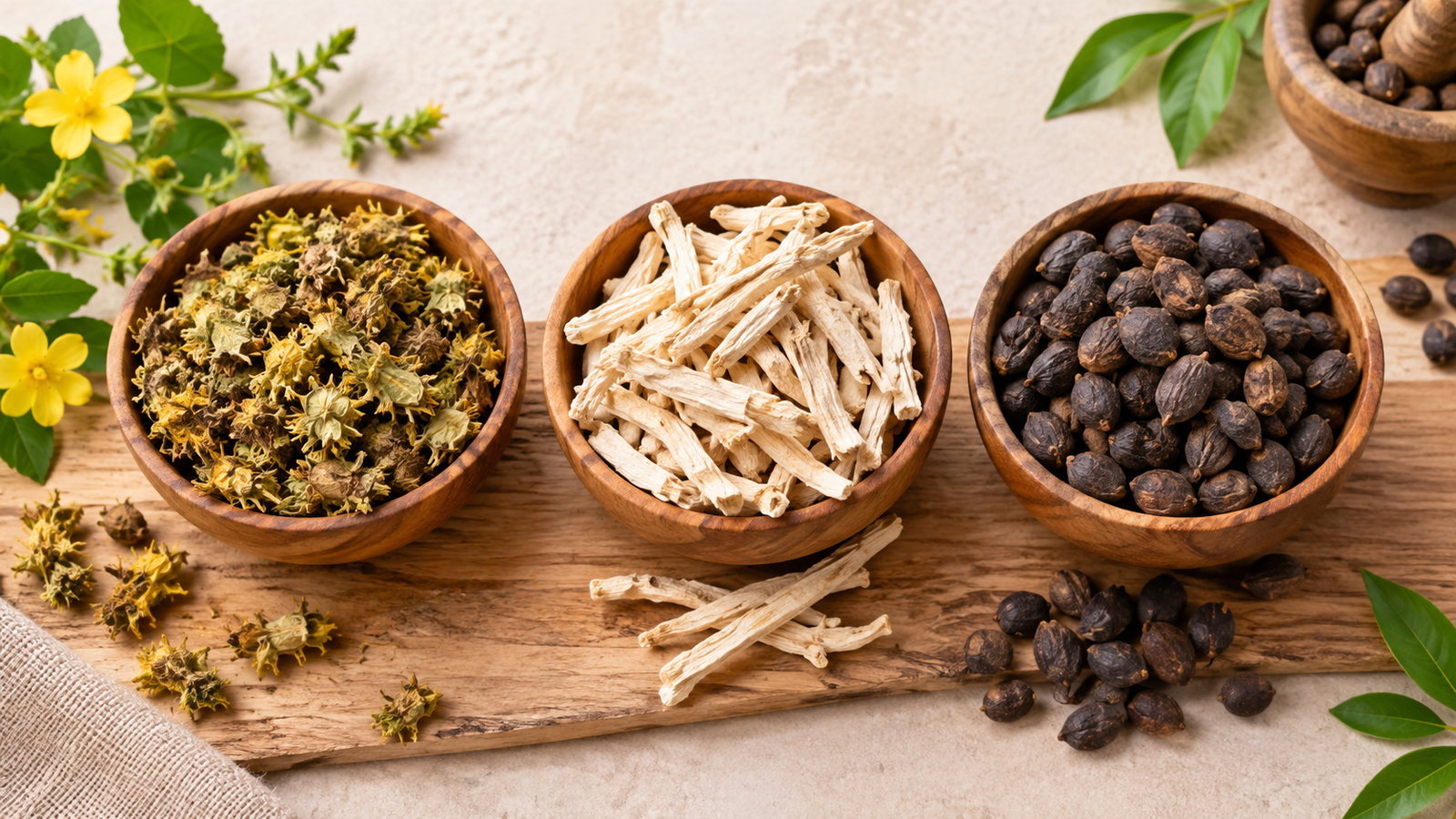
Kapikacchu: Supporting Testosterone Through Natural L-DOPA
Kapikacchu (Mucuna pruriens) is one of the most studied herbs in the context of sperm motility, largely due to its naturally occurring L-DOPA content — a direct precursor to dopamine in the body. Dopamine, in turn, plays a role in regulating the release of luteinizing hormone, which stimulates testosterone production in the testes.
This mechanism offers a plausible explanation for Kapikacchu’s traditional classification as a Vajikarana (reproductive tonic) herb: by supporting the dopamine pathway upstream, it may help optimize the hormonal environment necessary for healthy sperm development, including motility. Several studies involving men with fertility concerns have reported measurable improvements in both sperm motility and count following consistent Kapikacchu supplementation, lending scientific support to its long-standing traditional use.
Gokshura: Antioxidant Protection for Sperm Cells
Gokshura (Tribulus terrestris) is another cornerstone herb in Ayurvedic male fertility protocols, valued primarily for its antioxidant properties. Sperm cells are particularly vulnerable to oxidative damage due to the high concentration of polyunsaturated fatty acids in their cell membranes — damage that can directly impair motility and overall function.
By helping neutralize excess free radicals, Gokshura is believed to protect sperm cell membranes and the internal structures responsible for movement, potentially preserving and improving motility over time. It’s also traditionally valued for its supportive action on the broader urogenital system, making it a frequent component of comprehensive male fertility formulations rather than a standalone remedy.
Safed Musli: A Classical Vitality Tonic
Safed Musli (Chlorophytum borivilianum) holds a long-standing reputation in Ayurveda as a general vitality and reproductive tonic, often used alongside Ashwagandha and Kapikacchu in classical formulations. While research specifically isolating its effect on sperm motility is more limited compared to Kapikacchu and Gokshura, its traditional use centers on supporting overall reproductive strength, stamina, and semen quality.
Safed Musli is often included in compound formulations both for its own reputed benefits and for its complementary action alongside other Vajikarana herbs, contributing to a broader restorative effect rather than targeting a single parameter in isolation.
Shilajit: Mitochondrial Energy for Sperm Movement
Shilajit, a mineral-rich exudate found in the rocks of high mountain ranges, occupies a unique place in Ayurvedic fertility treatment due to its proposed effect on mitochondrial function. Sperm motility is fundamentally an energy-dependent process — the mitochondria packed into the midpiece of each sperm cell generate the energy required for movement. When mitochondrial function is compromised, motility often suffers as a direct result.
Shilajit is rich in fulvic acid and a range of trace minerals, and research has associated its use with improved sperm parameters, including motility and count, in men with fertility concerns. The proposed mechanism centers on Shilajit’s role in supporting cellular energy production — essentially helping power the mitochondrial “engines” that drive sperm movement. This makes it a particularly relevant addition for men whose motility concerns may be linked to underlying energy or metabolic depletion.
Classical Formulations: Ashwagandhadi Churna and Combined Protocols
In classical Ayurvedic practice, these herbs are rarely prescribed in isolation. Instead, they’re typically combined into compound formulations designed to work synergistically — a principle reflected in preparations like Ashwagandhadi Churna, a classical powder formulation built around Ashwagandha as a base, often combined with complementary herbs depending on the specific formulation and practitioner’s approach.
The logic behind combination formulas is that different herbs address different aspects of the same underlying issue — Kapikacchu supporting the hormonal pathway, Gokshura offering antioxidant protection, Shilajit supporting cellular energy, and Ashwagandha providing broader adaptogenic and stress-modulating support. Used together, these herbs are believed to address motility from multiple angles simultaneously, rather than relying on a single mechanism.
Why the 90-Day Treatment Cycle Matters
One detail that’s often underestimated in herbal fertility treatment is timing. Sperm undergo a complete regeneration cycle — from initial cell division to fully mature, motile sperm — that takes approximately 74 days, with additional time for transport and maturation bringing the practical window closer to 90 days.
This biological timeline is why Ayurvedic practitioners typically recommend a minimum 90-day course when using herbs to target sperm motility. Herbs introduced today won’t meaningfully affect the sperm already in circulation — their impact is on the next generation of sperm cells currently developing. Stopping treatment early, before this cycle completes, is one of the most common reasons patients don’t see the improvement they’re hoping for, even when using appropriate herbs.
A typical 90-day protocol involves consistent daily dosing of the selected herbal combination, ideally alongside supportive dietary and lifestyle measures, with a follow-up semen analysis at the end of the cycle to assess actual change in motility, count, and other relevant parameters
The Takeaway
Improving sperm motility through Ayurveda isn’t about a single miracle herb — it’s about a combination of targeted botanicals, each addressing a different piece of the puzzle, sustained consistently across the full sperm regeneration cycle. Kapikacchu’s hormonal support, Gokshura’s antioxidant protection, Safed Musli’s restorative action, and Shilajit’s mitochondrial support together reflect a comprehensive approach that classical Ayurveda arrived at long before modern science could explain the individual mechanisms at play.