Panchakarma Therapy for Fertility Enhancement: Complete Guide
At Dr. Narkhede Ayurved & Panchkarma Clinic, one of the questions I’m asked most often by couples preparing for conception is whether they really need detoxification before trying to conceive, or whether herbs and diet alone are enough. My answer, based on years of clinical experience, is consistent: for many patients, Panchakarma is the step that makes everything else work better. Herbs and Rasayana therapy can only nourish tissue effectively once the body’s channels are clear — and that’s precisely what Panchakarma is designed to do.
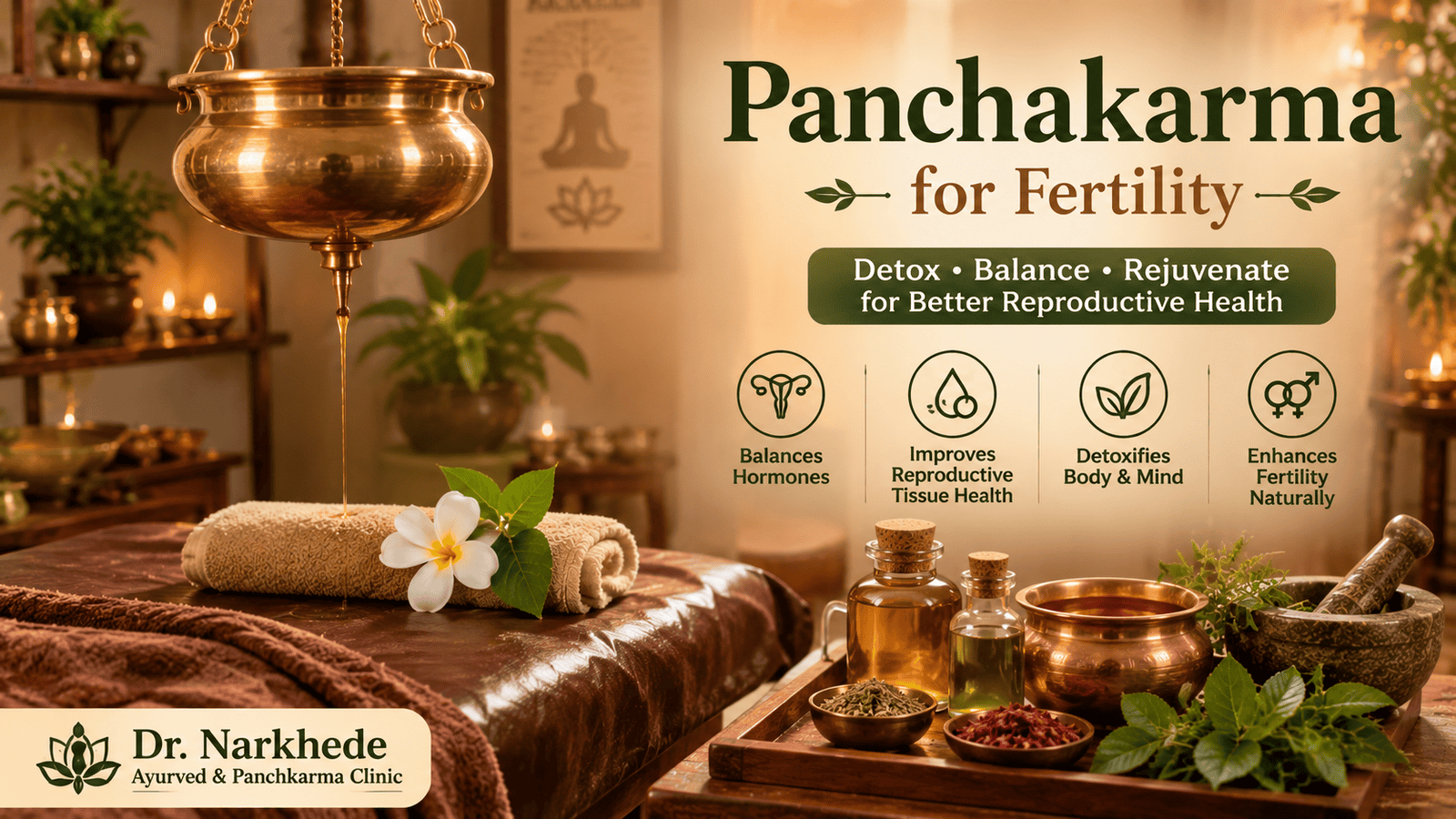
Panchakarma as a Pre-Conception Detoxification Protocol
Panchakarma literally means “five actions,” referring to five classical detoxification procedures used in Ayurveda to eliminate accumulated Ama (toxins) and restore dosha balance. While Panchakarma is used across many conditions, I find it particularly valuable in fertility care, where Ama accumulation in the reproductive channels (Artava-vaha and Shukra-vaha srotas) can quietly interfere with hormonal balance, ovulation, and sperm quality long before a couple even begins trying to conceive.
I often explain it to patients this way: Rasayana herbs are like nutrients you’re trying to deliver to a room, but if the doorway is blocked by clutter, the nutrients simply can’t get through effectively. Panchakarma clears that doorway. This is why, in my practice, I typically recommend a structured detoxification phase before beginning deeper reproductive tonification — not as an optional add-on, but as a genuine first step.
Basti: Medicated Enema for Vata and Reproductive Nourishment
Of the five Panchakarma procedures, Basti is the one I use most frequently in fertility cases, and for good reason. Vata is considered the primary governing force behind movement in the body — including ovulation, menstrual timing, and the transport mechanisms involved in conception. When Vata is aggravated, I commonly see this reflected in irregular cycles, anxiety, and reproductive dryness in my patients.
Basti involves the administration of medicated oils or herbal decoctions through the rectal route, and it’s considered the single most effective therapy for correcting Vata imbalance in classical Ayurveda. Beyond its balancing effect, certain Basti formulations are specifically chosen for their nourishing action on the reproductive organs, making this therapy valuable both for correcting Vata-driven irregularity and for direct reproductive tissue support. I typically administer Basti in structured courses, with the specific oils and duration tailored to each patient’s presentation.
Virechana: Purgation for Pitta-Related Hormonal Issues
For patients whose fertility concerns are more closely tied to Pitta imbalance — think inflammatory conditions, heavy or painful cycles, or hormonal excess — I often turn to Virechana, therapeutic purgation.
Virechana works by eliminating excess Pitta and associated Ama through the digestive tract, using medicated herbal preparations to induce controlled, therapeutic elimination. In my experience, this therapy is particularly useful for patients with conditions like endometriosis or inflammatory hormonal patterns, where excess heat and Pitta appear to be driving the underlying imbalance. As with all Panchakarma procedures, I precede Virechana with preparatory therapies — Snehana (internal oleation) and Swedana (sudation) — to properly loosen toxins before elimination, and I supervise the entire process closely given its intensity.
Uttar Basti: Targeted Support for Uterine Health
Among the specialized forms of Basti, Uttar Basti deserves particular mention for female fertility care. This is a more targeted procedure involving the introduction of medicated oils or decoctions directly into the uterus through the cervical route, and it’s one of the therapies I reserve specifically for cases involving uterine or tubal concerns.
I’ve found Uttar Basti particularly relevant for patients dealing with thin uterine lining, certain cases of blocked or partially compromised fallopian tubes, and general uterine nourishment ahead of conception attempts or embryo transfer. Because this procedure is more specialized and requires precise technique, I only perform it in a clinical setting with careful patient selection and preparation.
Garbhasanskar: The Pre-Conception Preparation Window
All of this detoxification work fits within a broader classical framework I place significant emphasis on in my practice: Garbhasanskar, Ayurveda’s structured approach to pre-conception and prenatal preparation. Garbhasanskar isn’t a single therapy — it’s a preparation philosophy, encompassing physical detoxification, dietary correction, herbal support, and mental-emotional readiness, all undertaken deliberately in the months before conception.
In my clinical approach, I typically recommend beginning Garbhasanskar preparation 1 to 3 months before actively trying to conceive, though this window can extend further for patients with more significant imbalances or a longer history of reproductive difficulty. This period allows time for:
- Panchakarma detoxification to clear Ama and correct dosha imbalance.
- Rasayana herbal support to rebuild and nourish Shukra and Artava Dhatu once the channels are clear.
- Dietary and lifestyle correction, giving the body’s tissues time to reflect improved nourishment.
- Mental and emotional preparation, which classical texts describe as directly influencing the quality of conception — something I’ve come to appreciate deeply in practice, given how closely stress and reproductive outcomes are linked.
Why Timing Matters So Much
I place a lot of emphasis on timing with my patients because Panchakarma and Rasayana therapy work in sequence, not simultaneously. Attempting to nourish reproductive tissue with Rasayana herbs before clearing Ama through Panchakarma is, in my experience, significantly less effective — it’s a bit like trying to paint over a wall that hasn’t been cleaned first. Similarly, undertaking intensive Panchakarma therapy too close to an active conception attempt isn’t appropriate either, since therapies like Virechana and Basti require a recovery and rebuilding phase afterward.
This is why I generally structure treatment as: detoxification first, rebuilding second, conception attempt third — with adequate time built in between each phase. For couples working with a specific timeline, such as an upcoming IVF cycle, I coordinate this Garbhasanskar window carefully with their fertility specialist to ensure the Ayurvedic preparation phase complements rather than conflicts with their medical treatment schedule.
A Final Note From My Practice
Panchakarma isn’t a one-time detox trend — in classical Ayurveda, it’s a precise, sequenced clinical protocol, and that’s exactly how I approach it at Dr. Narkhede Ayurved & Panchkarma Clinic. Whether it’s Basti for Vata correction, Virechana for Pitta-driven concerns, or Uttar Basti for targeted uterine support, each therapy is selected based on a patient’s specific imbalance, not applied as a generic package.
If you and your partner are preparing for conception and want to explore whether a Panchakarma-based Garbhasanskar protocol is right for you, I invite you to schedule a consultation at our clinic, where we’ll assess your constitution and build a properly sequenced preparation plan.
This article is for educational purposes and is not a substitute for professional medical advice. Panchakarma therapies, including Basti, Virechana, and Uttar Basti, should only be performed under the supervision of a qualified Ayurvedic practitioner. Please consult Dr. Sagar Narkhede before beginning any detoxification protocol, especially if you are actively undergoing fertility treatment.