
Kapikacchu (Mucuna Pruriens): Nature's Fertility Booster for Men
Among the herbs that Ayurveda has relied on for centuries to support male reproductive health, Kapikacchu (Mucuna pruriens), also known as velvet bean or cowhage, holds a distinctive place. While Ashwagandha is often celebrated for its adaptogenic action and Shilajit for its mineral richness, Kapikacchu stands out for something more specific: its naturally high content of L-DOPA, a compound with direct relevance to the hormonal pathways governing male fertility. Today, as modern research examines this herb more closely, it is increasingly clear that its traditional reputation rests on more than folklore.
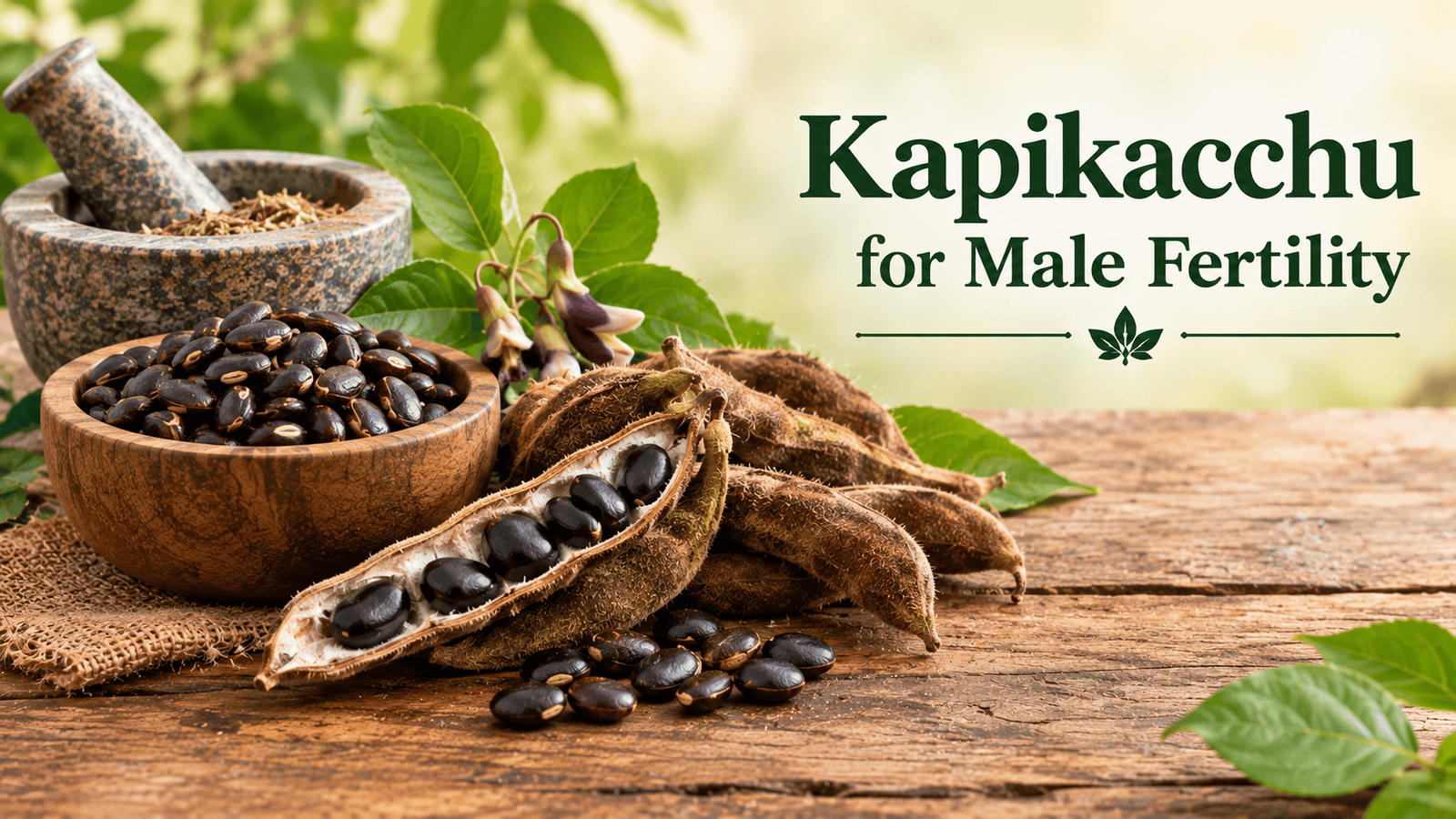
Kapikacchu as a Classical Vajikarana Herb
In classical Ayurveda, Kapikacchu is classified among the Vajikarana herbs — substances used to strengthen reproductive function, enhance vitality, and support healthy semen quality. Ancient texts describe it as Vrishya (promoting reproductive strength) and Balya (strength-giving), and it features prominently in traditional formulations intended to address male reproductive weakness, low vitality, and diminished semen quality.
Kapikacchu is also considered a Rasayana in certain contexts, meaning it’s valued not only for treating specific complaints but for nourishing and rejuvenating the body’s tissues more broadly. This dual classification reflects how Ayurveda views reproductive health: not as an isolated function, but as an expression of overall tissue nourishment and nervous system balance.
The L-DOPA Connection: Dopamine and Testosterone
The seeds of Kapikacchu are naturally rich in L-DOPA (levodopa), a direct biochemical precursor to dopamine, one of the brain’s key neurotransmitters. This is where the herb’s connection to male fertility becomes scientifically interesting.
Dopamine plays an important regulatory role in the hypothalamic-pituitary-gonadal (HPG) axis — the hormonal communication pathway that controls testosterone production and sperm development. In simplified terms, healthy dopamine signaling helps regulate the release of hormones that stimulate the testes to produce testosterone, which in turn supports spermatogenesis (sperm production). By supplying the body with a natural dopamine precursor, Kapikacchu may help support this upstream signaling pathway.
Dopamine also has an inverse relationship with prolactin, a hormone that, when elevated, can suppress testosterone and impair fertility. Some research suggests Kapikacchu’s L-DOPA content may help moderate elevated prolactin levels, offering a second potential pathway through which the herb supports reproductive hormone balance. This combination of effects — supporting dopamine and testosterone while modulating prolactin — helps explain why Kapikacchu has remained a cornerstone of Ayurvedic male fertility protocols.
Research on Sperm Count, Motility, and Oxidative Stress
Modern clinical studies have begun to evaluate Kapikacchu’s effects on semen parameters, with promising findings. Research involving men with fertility concerns has reported:
- Improved sperm count, with increases in sperm concentration observed following consistent supplementation.
- Improved sperm motility, an important parameter given how directly it affects the ability of sperm to reach and fertilize an egg.
- Reduced oxidative stress markers in semen. Oxidative stress — an imbalance between free radicals and antioxidant defenses — is one of the most significant contributors to sperm DNA damage and impaired function. Studies on Kapikacchu have noted improvements in oxidative stress markers and enhanced antioxidant levels in seminal plasma, suggesting a protective effect on sperm cells themselves.
- Hormonal improvements, including increased testosterone and reduced stress-related hormones such as cortisol, in some study populations.
While these findings are encouraging, it’s worth noting that many studies involve relatively small groups, and larger, long-term trials would help clarify exactly which men benefit most and at what dosage. As with most herbal interventions, individual responses vary, and results typically depend on consistent use over a sustained period.
Traditional Preparation Methods
Kapikacchu has been prepared and consumed in several traditional ways, each reflecting classical Ayurvedic principles of enhancing absorption and balancing the herb’s properties:
Churna (powder). The most common form, made from processed, ground Kapikacchu seeds and typically taken with warm milk — a classical vehicle for reproductive tonics believed to enhance nourishment and support absorption.
Ksheerapaka (milk decoction). Kapikacchu powder simmered in milk, a traditional preparation for Vajikarana herbs, believed to improve both digestibility and tissue-nourishing effect.
Compound formulations. Kapikacchu is frequently included in classical multi-herb preparations alongside Ashwagandha, Gokshura, and Safed Musli, reflecting the Ayurvedic principle of combining herbs for broader, synergistic action.
Standardized extracts and capsules. Modern supplementation often uses standardized seed extracts with specified L-DOPA content, offering more consistent dosing than traditional raw powder preparations.
Traditionally, Kapikacchu seeds undergo a purification process called Shodhana before medicinal use, in order to reduce potentially irritating compounds. This is an important detail — raw, unprocessed seeds and the plant’s hairy pods are not suitable for consumption, and properly prepared products from reputable sources are essential.
Safety Considerations for Long-Term Use
While Kapikacchu has a long history of traditional use, its L-DOPA content means that certain precautions deserve genuine attention:
Medication interactions. Because L-DOPA directly affects dopamine pathways, Kapikacchu may interact with medications that influence dopamine or neurological function — including drugs for Parkinson’s disease, antipsychotics, antidepressants (particularly MAO inhibitors), and certain blood pressure medications. Anyone on such medications should consult a doctor before use.
Mental health considerations. Because of its effect on dopamine, individuals with a history of psychiatric conditions such as psychosis, bipolar disorder, or severe anxiety should avoid Kapikacchu or use it only under close medical supervision.
Digestive and other side effects. Some users experience nausea, digestive discomfort, headaches, or restlessness, particularly at higher doses. Starting with a lower dose and increasing gradually, under practitioner guidance, is generally the safer approach.
Duration of use. For fertility purposes, courses are typically aligned with the roughly 90-day sperm regeneration cycle, followed by reassessment, rather than open-ended indefinite use. Long-term continuous use should be guided by a qualified practitioner, ideally with periodic monitoring.
Pregnancy and breastfeeding. Kapikacchu is generally not recommended for use by pregnant or breastfeeding women.
Surgery. Because of its effect on dopamine and blood pressure, it’s generally advised to stop use before scheduled surgery, as directed by a physician.
The Takeaway
Kapikacchu offers a compelling example of how traditional Ayurvedic knowledge and modern research can converge. Its classical role as a Vajikarana herb aligns closely with what scientists now understand about its L-DOPA content, dopamine support, and potential effects on testosterone, sperm count, motility, and seminal oxidative stress. At the same time, its pharmacologically active nature means it deserves respect — proper preparation, appropriate dosing, awareness of medication interactions, and guidance from a qualified practitioner are all essential to using it safely and effectively as part of a broader male fertility protocol.