Shatavari Benefits for Female Reproductive Health & Fertility
If Ashwagandha is Ayurveda’s flagship herb for male vitality, Shatavari for fertility (Asparagus racemosus) holds the equivalent position for women. Its very name offers a clue to its reputation — often translated as “she who possesses a hundred husbands” or “she who has a hundred roots,” a poetic nod to its long-standing association with feminine strength, fertility, and reproductive endurance. For centuries, Shatavari has been the go-to Rasayana (rejuvenative tonic) for women across every stage of reproductive life, from menstruation through pregnancy, postpartum recovery, and menopause.
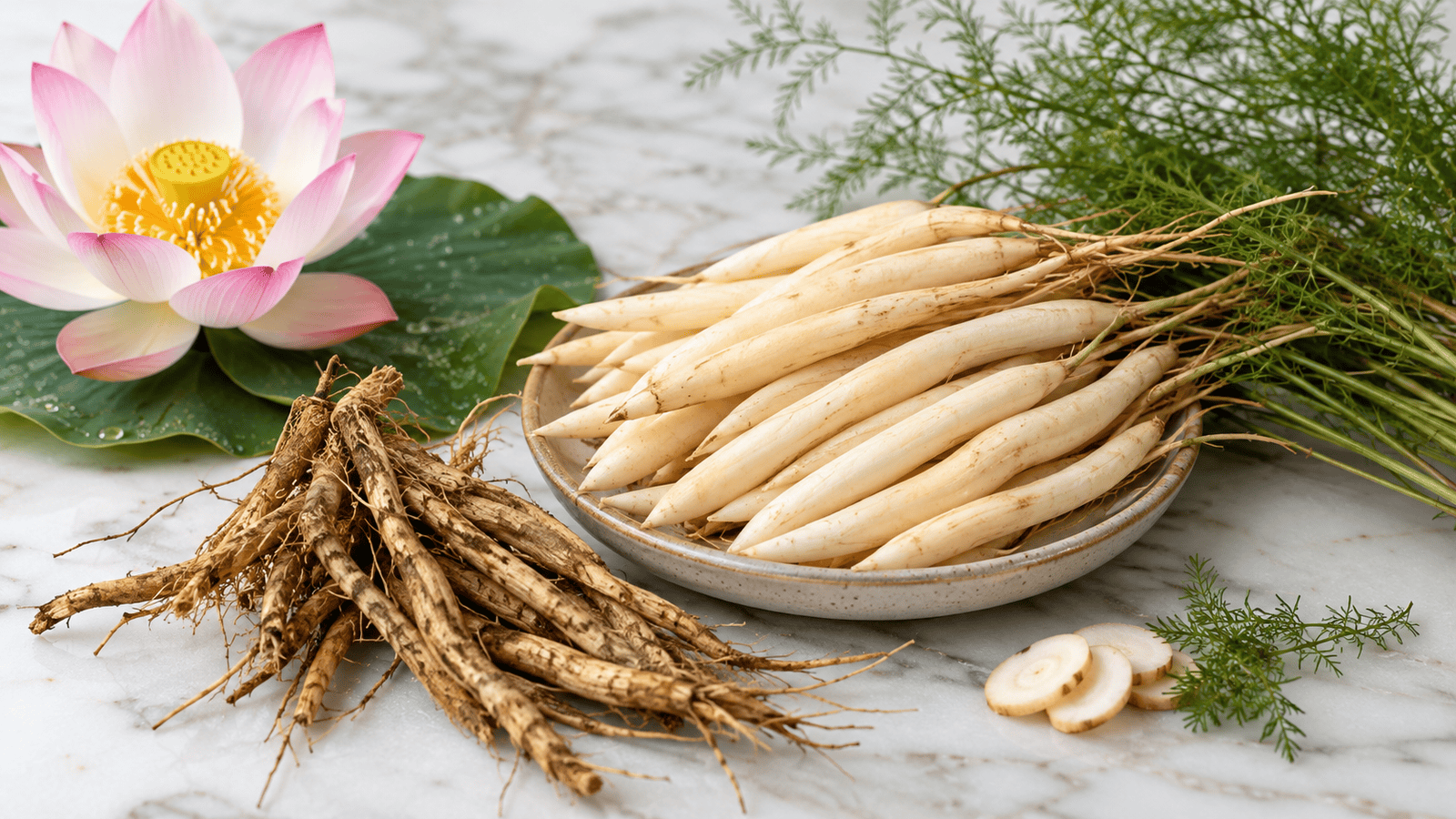
Shatavari as the Primary Female Reproductive Rasayana
In Ayurveda, Rasayana herbs are those believed to nourish and rejuvenate the body’s tissues at a deep level, slowing depletion and restoring vitality. Shatavari holds a special place within this category specifically for its affinity to the female reproductive system. Classical texts describe it as Stanya Janana (galactagogue, supporting lactation), Garbhasthapana (pregnancy-supportive), and broadly restorative to reproductive strength.
Unlike herbs used to treat a single symptom, Shatavari was traditionally prescribed as a long-term tonic — something taken consistently over months to build reproductive resilience rather than address an isolated issue. This makes it distinct from more targeted remedies and closer in philosophy to a foundational, ongoing support herb.
Nourishing Artava Dhatu: Ayurveda's View of Ovarian Health
Central to Shatavari’s reputation is its role in nourishing Artava Dhatu — the Ayurvedic term for the reproductive tissue that governs menstruation, ovulation, and overall ovarian function in women. Artava Dhatu is considered a refined byproduct of the body’s deeper tissue layers, meaning its quality reflects the health of the entire system, not just the reproductive organs in isolation.
When Artava Dhatu is well-nourished, Ayurveda associates this with regular cycles, healthy ovulation, and strong reproductive stamina. When depleted — often due to poor digestion, chronic stress, or nutritional deficiency — irregular periods, low ovarian reserve symptoms, or difficulty conceiving may follow. Shatavari’s cooling, moistening, and nutritive qualities are traditionally used to counteract this depletion, particularly in cases where dryness, thinness, or Vata-type irregularity are present.
Estrogen Balance and Uterine Lining Support
One of the more specific and widely discussed applications of Shatavari is its relationship to estrogen activity. Ayurvedic practitioners have long used it to support women experiencing irregular cycles, low estrogen symptoms, or thin uterine lining — a factor that can affect implantation and pregnancy outcomes.
The proposed mechanism, further explored in modern research, lies in Shatavari’s phytoestrogenic compounds — plant-based molecules that can weakly mimic or modulate estrogen activity in the body. This dual-direction action is part of what makes phytoestrogens interesting: rather than simply adding estrogen, they can help modulate receptor activity, offering a more balancing rather than purely stimulating effect. This is thought to be part of why Shatavari has traditionally been used both to support uterine lining thickness in low-estrogen states and to ease symptoms in states of hormonal fluctuation.
Easing Perimenopausal Symptoms
Shatavari’s use isn’t limited to the fertility years. As women transition into perimenopause, declining and fluctuating estrogen levels often bring hot flashes, mood changes, vaginal dryness, and sleep disruption. Ayurveda has long used Shatavari during this transition, again leaning on its phytoestrogenic and Rasayana properties to help ease this hormonal shift more gradually and comfortably.
This lifelong applicability — from menstrual years through menopause — reflects Ayurveda’s broader philosophy that reproductive health isn’t a phase to manage only when trying to conceive, but a continuous thread of vitality worth supporting throughout a woman’s life.
Usage Across the Menstrual Cycle
Shatavari is typically used as a continuous daily tonic rather than a cycle-phase-specific remedy, though some traditional protocols do adjust its use slightly:
- Follicular phase (post-menstruation to ovulation): Often used to support healthy estrogen rise and follicular development.
- Luteal phase (post-ovulation to next period): Continued use is believed to support progesterone balance and uterine lining maintenance.
- During menstruation: Some practitioners recommend continuing at a lower dose, while others pause briefly — this varies by practitioner and individual constitution.
Because Shatavari works as a gradual, nourishing tonic rather than a fast-acting remedy, consistency across the full cycle — sustained over at least 2–3 months — is generally considered more important than precise timing.
Traditional Preparation: With Milk or Ghee
Classical Ayurvedic preparation methods pair Shatavari with milk or ghee, and this isn’t incidental — both are considered ideal carriers (Anupana) for reproductive tonics.
Shatavari with milk (Ksheerapaka): Shatavari powder simmered in warm milk is one of the most traditional preparations, believed to enhance its nourishing, tissue-building qualities while making it easier to digest and assimilate.
Shatavari Ghrita (medicated ghee): Ghee is considered an excellent medium for delivering fat-soluble compounds deep into bodily tissues, including reproductive tissue. Shatavari-infused ghee is a classical formulation specifically used for uterine and ovarian nourishment.
Shatavari Churna (powder) with water or honey: A simpler daily form, often used when milk or ghee isn’t preferred or suitable.
What Modern Research Says About Its Phytoestrogenic Properties
Contemporary studies on Asparagus racemosus have begun to explore the plant chemistry behind its traditional reputation. Research has identified steroidal saponins — compounds called shatavarins — as key active constituents, some of which demonstrate estrogen-modulating activity in laboratory studies. This phytoestrogenic action offers a biochemical explanation for Shatavari’s traditional use in supporting estrogen balance, uterine health, and menopausal symptom relief.
Additional research has explored Shatavari’s antioxidant and adaptogenic properties, both of which may contribute indirectly to reproductive health by reducing cellular stress on ovarian and uterine tissue. While human clinical trial data is still growing, particularly around specific fertility outcomes, the existing evidence lends meaningful support to centuries of traditional use.
The Takeaway
Shatavari’s standing as Ayurveda’s primary female reproductive Rasayana isn’t based on a single mechanism, but on a broad, whole-system approach to nourishing Artava Dhatu, supporting hormonal balance, and sustaining reproductive vitality across every life stage. Its traditional pairing with milk or ghee reflects a deep understanding of how to deliver nourishment effectively, while modern research into its phytoestrogenic compounds is beginning to validate what Ayurvedic practitioners have observed for generations.
As with any reproductive tonic, Shatavari works best as part of a sustained, personalized routine — ideally guided by a qualified Ayurvedic practitioner who can tailor dosage and form to individual needs.
Shatavari for fertility Anandnagar.