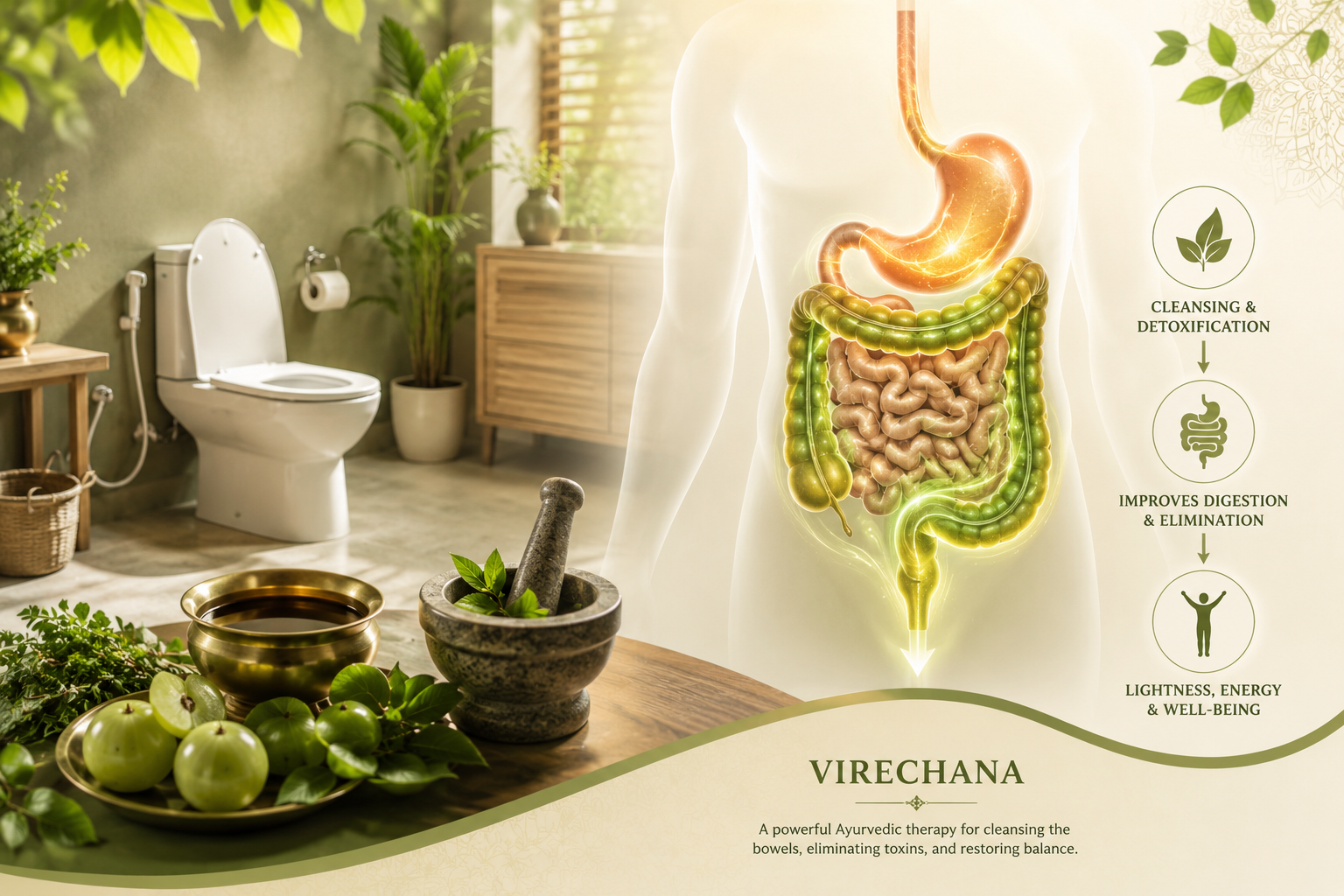
Virechan Panchakarma
Virechan Panchakarma: Benefits for Male and Female Fertility Treatment
Virechan is one of the most frequently used Panchakarma therapies at the clinic, for a simple reason — a large share of fertility conditions in both women and men involve vitiated Pitta and Kapha, and Virechan is the therapy specifically designed to clear exactly this kind of toxin accumulation. This article explains what Virechan involves and how it supports fertility treatment for women and men alike.
What Virechan is
Virechan (विरेचन) is a controlled, medically supervised purgation therapy carried out after proper Purvakarma preparation (Abhyanga and Swedan). Medicated herbs are administered to induce a therapeutic purgative action that clears vitiated Pitta and Kapha, along with accumulated Ama (undigested toxin), from the digestive and reproductive systems. Like all Panchakarma therapies, it is timed and dosed precisely by the physician rather than being a generic purgative — a clinical procedure, not a home remedy.
Why Pitta-Kapha clearing matters for fertility
Ayurveda holds that Ama, once formed from weak Agni (digestive fire), doesn’t stay confined to the digestive tract — it settles into deeper tissues and the reproductive channels (Artava vaha srotas in women, Shukravaha srotas in men), where it contributes to inflammation, congestion, and poor tissue quality. Virechan addresses this at a systemic level, rather than only treating the reproductive organs in isolation.
Benefits for female fertility
- PCOD/PCOS — Virechan clears the Kapha-Ama congestion that underlies irregular ovulation, helping restore more regular follicular development over subsequent cycles.
- Endometriosis — By clearing vitiated Pitta and the toxins that aggravate inflammation, Virechan supports a reduction in the cyclical inflammatory pattern behind endometriosis pain.
- Uterine fibroids — Virechan is considered central to fibroid management, since clearing Ama and reducing Kapha-Pitta vitiation works directly against the Granthi (nodule) formation process.
- Menstrual irregularity — Where heavy or prolonged bleeding reflects Pitta-Rakta vitiation, Virechan helps correct the excess heat and toxin load behind it.
Benefits for male fertility
- Semen quality — Ama accumulation in the Shukravaha srotas is understood to affect the quality of Shukra dhatu, contributing to poor sperm parameters. Virechan’s clearing action supports the body’s ability to form healthier reproductive tissue.
- Reducing excess Pitta-driven heat — Conditions involving excess heat in the reproductive tract, understood in Ayurveda as Pitta vitiation, can affect sperm health; Virechan helps correct this heat imbalance.
- Supporting overall metabolic health — Since Kapha-Ama accumulation is also linked to obesity and metabolic sluggishness in men, Virechan’s detoxifying effect can indirectly support the hormonal and metabolic balance that underlies healthy sperm production.
What to expect
Virechan follows the same three-stage Panchakarma structure — Purvakarma preparation, the main purgative therapy, and a structured Paschatkarma diet to help the body recover and stabilise afterward. It is generally more tolerable than Vaman for most patients, though it still requires proper preparation and supervision. Dr. Sagar Narkhede assesses each patient’s Prakriti, current health, and degree of Pitta-Kapha vitiation before recommending it as part of a treatment plan for either partner.
If you or your partner are dealing with a fertility condition linked to Pitta-Kapha imbalance and want to know whether Virechan is appropriate, Dr. Narkhede Ayurved & Panchkarma Clinic offers a personalised consultation with Dr. Sagar Narkhede to assess Prakriti and dosha imbalance before recommending the right Panchakarma therapy.